Restorative Yoga vs Yin Yoga: What Is the Difference?
YogaLife Journal
Restorative Yoga vs Yin Yoga · Wilmslow & Handforth · Updated September 2026
Restorative Yoga and Yin Yoga both slow the pace, use floor-based shapes and leave time for stillness. The experience, however, is not the same. Restorative Yoga uses generous support to reduce effort; Yin Yoga uses longer, mostly passive holds that create a clear but manageable sensation.
The better choice depends on what you need that day. If your priority is deep rest and comfort, Restorative is usually the closer match. If you want quiet practice with more physical sensation and time to explore range of movement, Yin may suit you better.
Neither class should be judged by how dramatic a pose looks. The quality of support, your breathing, the teacher’s guidance and your ability to leave a position safely matter far more.
Different purposes, not competing versions
Restorative Yoga is organised around ease. Blankets, bolsters, blocks and other supports hold much of the body’s weight so muscular effort can soften. A class may include only a small number of positions, with time to settle before and after each one.
Yin Yoga is quieter than a flow class but usually asks more of the body than Restorative. Most positions are seated or lying down and are held without repeated movement. The intention is not to collapse into the deepest possible shape; it is to find a sustainable position, become still and observe sensation over time.
Choose Restorative when you want
- minimal physical demand;
- substantial support from props;
- space to settle and rest;
- a lower-energy addition to your week;
- comfort to be the main priority.
Choose Yin when you want
- long, quiet floor-based holds;
- a noticeable but manageable stretch sensation;
- time to explore stillness and patience;
- less movement than Hatha or Flow;
- a practice that is slow but not necessarily easy.
Both can support general wellbeing, but neither should be presented as a cure for stress, pain, poor sleep or a health condition. Yoga research covers many different practices, which makes broad claims difficult to apply to one particular style.
How long are the poses held?
Restorative positions may be held for five, ten or even more minutes when the body is fully supported and comfortable. The exact time is less important than the ability to remain without strain, bracing or a growing urge to escape the position.
Yin holds are often shorter—commonly around three to five minutes in a general class—although teachers vary the duration for beginners, different poses and individual needs. There may also be a neutral pause between sides so you can notice how the body responds.
A longer hold is not automatically more effective. Leave early if sensation becomes sharper, spreads, creates pins and needles or makes the breath tense. On some days, one or two minutes may be the appropriate version.
Useful rule: choose a position you could make slightly deeper, then do not take that extra step. Time can change the sensation even when you remain still, so leave room to adjust.
Props: support for different reasons
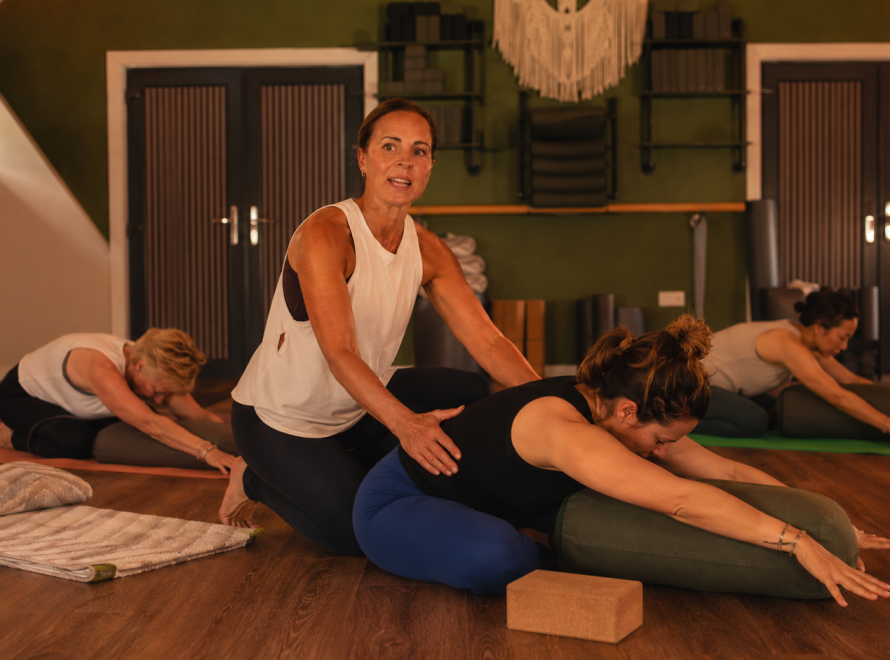
Both styles use props, but their job is different. In Restorative Yoga, props are arranged to remove as much unnecessary effort as possible. A bolster might support the entire torso, blankets may fill space beneath the limbs and an eye pillow can reduce stimulation.
In Yin Yoga, blocks, cushions and blankets usually reduce the depth or intensity of a position. A block beneath the knees in a seated fold, for example, may allow the legs and back to settle without forcing range. The prop makes the hold more sustainable; it does not necessarily remove all sensation.
- Bolster: supports the torso, knees or hips and reduces muscular holding.
- Blocks: bring the floor closer or limit depth.
- Blankets: add warmth, soften pressure and fill smaller gaps.
- Strap: supports the limbs without pulling them into position.
- Chair or wall: offers an alternative when floor transfers or a particular shape are unsuitable.
Tell the teacher if lying flat, kneeling, getting to the floor or changing position is difficult. The best prop setup is one you can enter and leave safely—not the most elaborate arrangement in the room.
What should each style feel like?
Restorative Yoga should feel supported enough that you can reduce effort. You may still notice a gentle opening, the contact of the props or areas that take time to settle, but increasing stretch is not the goal. If you are continually gripping, balancing or holding yourself up, ask for another setup.
Yin usually includes a clearer sensation. Think broad, steady and tolerable rather than sharp, electric or pinching. The feeling may change during a hold, so stay attentive instead of deciding in the first few seconds that the position is safe for several minutes.
Pain is not a sign that a pose is working. Come out for numbness, tingling, joint pressure, burning, dizziness or unusual breathlessness. Moving slowly after a long hold is sensible because the body may temporarily feel stiff or unfamiliar.
Yoga should never become a test of discomfort tolerance. Different anatomy, previous injuries and daily energy levels mean two people may need completely different versions of the same instruction.
Stillness and mental focus
Restorative practice often directs attention towards comfort, breathing and the experience of settling. Silence, guided relaxation or simple awareness may form a significant part of the class. Falling asleep is not required, and feeling restless does not mean you are doing it badly.
Yin asks you to remain present while sensation and thoughts change. That can involve patience, curiosity and the decision not to react to every small feeling. However, mindful observation does not mean ignoring a clear warning from the body.
Some people find stillness immediately calming; others find it challenging, especially during stress, grief or trauma. Keep your eyes open, change position or step outside if that helps you feel grounded. A good teacher will not demand that everyone closes their eyes or stays completely still.
If meditation or breath awareness increases distress, speak to an appropriate professional. Yoga can complement mental-health care but should not delay or replace it.
Who suits Restorative or Yin Yoga?
Restorative Yoga can work well for beginners, people seeking a low-demand session and anyone balancing a busy training week. It can also be useful when energy is limited, provided the positions suit the individual and any health guidance is followed.
Yin may appeal to people who enjoy quieter practice but still want a physical component. It is often accessible to beginners because transitions are slow, yet the long holds require judgement. Being flexible is not an advantage if it encourages you to move beyond a controllable range.
Pregnancy, recent surgery, joint instability, acute injury, significant osteoporosis, neurological symptoms and some circulation or eye conditions may require specific changes or professional advice. Avoid assuming that a slow class is automatically suitable for every condition.
The NCCIH advises learning yoga with a qualified instructor, avoiding extreme practices when new and discussing individual needs when health conditions affect participation. Tell the teacher before class rather than waiting until a difficult position appears.
Restorative Yoga vs Yin Yoga comparison
| Feature | Restorative Yoga | Yin Yoga |
|---|---|---|
| Main purpose | Supported rest and reduced effort. | Quiet, sustained exploration of positions and sensation. |
| Physical demand | Usually very low. | Low movement, but holds may feel physically challenging. |
| Typical hold | Often 5–10 minutes or longer when comfortable. | Often around 3–5 minutes, adapted as needed. |
| Use of props | Generous support intended to minimise muscular work. | Support used to manage depth, pressure and sustainability. |
| Expected sensation | Comfortable, settled and well supported. | Noticeable but steady and non-painful. |
| Common positions | Reclined, side-lying or gently supported shapes. | Mostly seated or lying folds, hip positions and gentle backbends. |
| Best fit | Rest, lower-energy days and nervous-system downshifting. | Stillness with more physical sensation and mobility-focused practice. |
| Beginner note | Ask for help arranging props and leaving poses. | Begin with shorter holds and more support than you think you need. |
How to choose the right YogaLife class
Choose from your current need rather than your usual identity. A regular runner may need Restorative after a demanding week; someone who normally prefers gentle exercise may enjoy the focused challenge of Yin.
- Choose Restorative if you want comfort, extensive support and minimal effort.
- Choose Yin if you want long, still positions with a controlled stretch sensation.
- Try both if your goals change across the week. They can complement rather than replace one another.
- Ask first if you have an injury, need chair-based options or are unsure whether floor work is suitable.
Read YogaLife’s Restorative Yoga class page and Yin Yoga class page, then check the current timetable. For a wider comparison, use the YogaLife class guide.
Frequently asked questions
Is Yin Yoga the same as Restorative Yoga?
No. Both are slow, but Restorative aims to reduce effort through extensive support. Yin normally retains a clearer physical sensation during sustained holds.
Which is better for beginners?
Either can be beginner-friendly with good teaching. Restorative may feel more immediately accessible, while Yin requires careful intensity choices. Tell the teacher you are new.
Which is better after exercise?
Restorative is usually the lower-demand recovery option. Yin can feel demanding after hard training, so reduce the depth and duration or choose another day.
Can I do Yin and Restorative in the same week?
Yes. For example, use Yin when you want quiet mobility work and Restorative when you want a more restful session. Allow the rest of your training and recovery to guide frequency.
Do I need to bring my own props?
Check the studio’s current arrangements before attending. Comfortable layers and socks for the beginning and end of class can also help in a low-movement session.
Continue exploring YogaLife
Further reading
Important: This article provides general information and is not medical advice. Work within your own limits and seek professional guidance when a health condition, injury, pregnancy or persistent symptom may affect participation.
SLOW DOES NOT ALWAYS MEAN THE SAME THING.
Choose the class your week needs
Compare Restorative and Yin classes, then ask the YogaLife team if you need help choosing.