

Yoga for Better Sleep: An Evening Routine to Help You Wind Down
YogaLife Journal
Evening yoga guide · Wilmslow & Handforth · Updated September 2026
Gentle evening yoga can become part of a reliable wind-down routine, but it is not a guaranteed cure for insomnia. The most useful practice is quiet, comfortable and easy to repeat—without turning bedtime into another performance target.
Yoga may help some people settle through slow movement, supported rest and focused breathing. The evidence for yoga as a treatment for insomnia remains limited, so it should complement sound sleep habits and appropriate healthcare rather than replace them.
This guide gives you a practical 15-minute routine and explains how to adapt it. If you prefer teacher-led support, explore Restorative Yoga and Yoga Nidra, Yin Yoga or YogaLife’s current timetable.
Can yoga help you sleep better?
Sleep problems have many causes, including stress, changing schedules, noise, pain, medicines, menopause, shift work and sleep disorders. Yoga cannot identify or remove all of these causes. What it can offer is a structured transition from activity into rest.
A suitable evening practice may reduce stimulation, shift attention away from work and make room for slower breathing and comfortable movement. That can support relaxation, but feeling relaxed does not guarantee immediate sleep. Trying too hard to “make yoga work” can create more pressure.
NCCIH reports that some studies have found yoga helpful for sleep in particular groups, but clinical guidance has considered the evidence insufficient to recommend yoga as an insomnia treatment. Cognitive behavioural therapy for insomnia (CBT-I) has stronger support for chronic insomnia.
Reasonable aims
- create a predictable wind-down cue;
- release the pace of the working day;
- move gently after sitting;
- reduce stimulation before bed;
- notice whether tension is settling.
Claims to avoid
- guaranteeing sleep in minutes;
- curing chronic insomnia;
- replacing medical assessment;
- forcing the body into deep stretches;
- treating one poor night as failure.
Calming yoga poses for the evening
The best evening positions require little effort and can be supported fully. There is no special pose that switches sleep on. Choose positions in which your breathing remains ordinary and your muscles do not have to work to keep you safe.
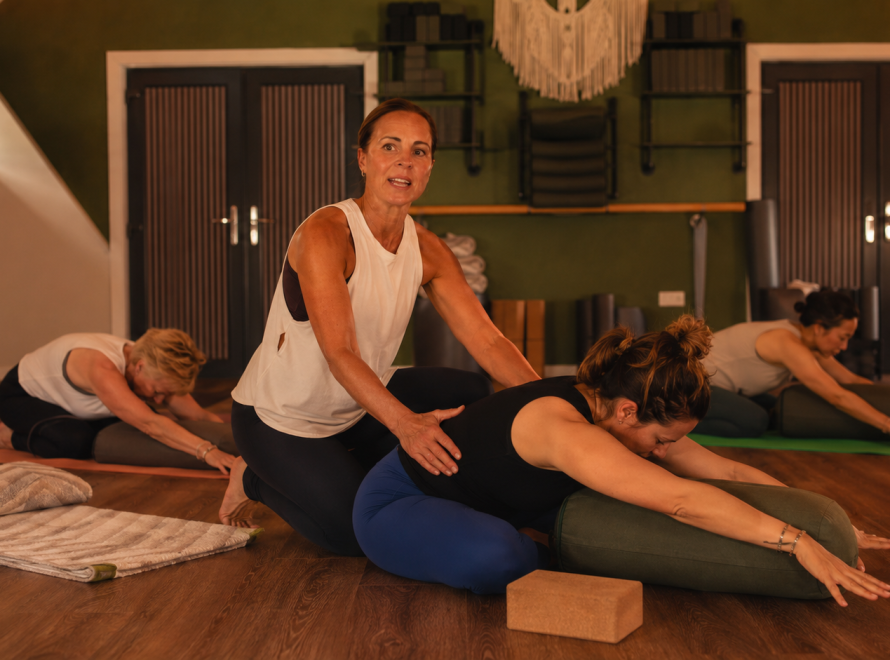
Supported child’s pose
Kneel only if comfortable, widen the knees and rest the torso on stacked cushions or a bolster. Turn the head to one side and change sides halfway. If knees, hips or ankles object, choose a chair-supported forward rest instead.
Reclined bound-angle variation
Lie back with the upper body supported. Place cushions beneath both thighs and keep the feet further away if the hips feel strained. The position should feel held, not stretched.
Lower legs on a chair
Lie on your back and place calves on a chair or sofa so the knees and hips are comfortable. This is often easier to control than placing the legs vertically up a wall.
Gentle reclined twist
With knees bent, allow both legs to move a small distance to one side. Support them with pillows and keep both shoulders comfortable. Skip twisting if it aggravates back, hip or abdominal symptoms.
Supported rest
Lie on your side or back with enough support beneath the head and knees. Use the position you could remain in without fidgeting or effort; a conventional savasana shape is not compulsory.
Make it easier: practise on a mat or carpet near your bedroom, use soft lighting, keep blankets ready and avoid positions that require concentration, balance or strong upper-body support.
Gentle breathing without forcing
Start by letting the breath move naturally. If breath focus feels calming, count a comfortable inhale and exhale—for example, three counts in and three counts out. You can allow the exhale to become one count longer, but only if that feels easy.
Do not take repeated oversized breaths or chase a very long exhale. Stop counting if you feel air hunger, dizziness, tingling or anxiety. Return to ordinary breathing and open your eyes. People with respiratory, heart or other relevant conditions should follow individual clinical advice.
Some people find internal focus uncomfortable, particularly during anxiety or after trauma. Use an external anchor instead: listen to quiet sounds, feel the support beneath you or name objects in the room. Read Breathwork for Beginners for a fuller safety guide.
A 15-minute evening yoga routine
Complete this routine around an hour before bed if practical, or earlier if movement close to bedtime makes you alert. Keep every range small and comfortable. Stop if you experience pain, dizziness, numbness or unusual breathlessness.
| Time | Practice | How to adapt |
|---|---|---|
| 0–2 minutes | Supported sitting or lying; notice contact with the floor and allow natural breathing. | Keep eyes open if closing them feels uncomfortable. |
| 2–4 minutes | Slow cat–cow or a small seated spinal wave. | Use a chair if wrists, knees or getting to the floor are difficult. |
| 4–7 minutes | Supported child’s pose or chair-supported forward rest. | Keep the head and torso fully supported; skip deep folding. |
| 7–10 minutes | Gentle reclined twist, about 90 seconds each side. | Support the knees and reduce the range. |
| 10–13 minutes | Lower legs on a chair with natural or gently counted breathing. | Bend the knees with feet on the floor if the chair position is uncomfortable. |
| 13–15 minutes | Supported rest; release counting and let attention widen. | Lie on your side and use blankets for warmth. |
Finish slowly. Roll to one side, pause and sit up only when ready. Go into the next quiet part of your bedtime routine rather than returning to emails or scrolling.
Sleep habits to combine with yoga
Yoga is more useful when it sits inside a broader routine. NHS guidance recommends consistent sleep and wake times, a relaxing period before bed and a bedroom that is dark and quiet. Regular daytime physical activity can also support sleep.
- Keep a regular wake time: avoid repeatedly sleeping late after a poor night.
- Create a wind-down hour: lower stimulation and choose reading, quiet music, breathing or gentle yoga.
- Review caffeine, nicotine and alcohol: all can interfere with sleep; caffeine may need to stop several hours before bed.
- Avoid a large late meal: give digestion time before lying down.
- Make the room sleep-friendly: aim for dark, quiet and comfortably cool.
- Reduce screen use before bed: move the phone away and stop work messages.
- Do not force sleep: if you remain awake, get up and do something quiet until sleepy.
Track patterns for two weeks rather than judging one night. Note bedtime, wake time, caffeine, evening activity and how you felt the next day. Avoid obsessively clock-watching in bed.
Which YogaLife classes suit an evening wind-down?
Restorative Yoga and Yoga Nidra is the clearest fit when you want extensive support, minimal physical demand and guided rest. Yoga Nidra is a relaxation practice; falling asleep during it is not required.
Restorative Yoga uses props to support positions for longer periods. Check that the class timing leaves you enough time to travel home and settle.
Yin Yoga offers slower floor-based positions, but longer holds can still be physically intense. Stay well within your range and use props rather than chasing a deep sensation. Read What Is Yin Yoga?.
Slow Flow or Hatha may suit earlier evening when you want gentle movement before stillness. Power, hot or fast Vinyasa classes may be enjoyable at night, but move them earlier if they leave you alert or interfere with sleep.
Compare timing choices in Morning Yoga vs Evening Yoga.
When sleep problems need professional help
Speak to a GP if changing your sleep habits has not helped, you have struggled for months, or poor sleep is affecting daily life and making it hard to cope. A clinician can explore causes, review medicines and discuss treatments such as CBT-I.
Seek assessment for loud snoring with interrupted breathing, choking or gasping during sleep, severe daytime sleepiness, falling asleep unexpectedly, persistent restless legs, or other symptoms suggesting a sleep disorder. Do not drive when sleepy.
Urgent help is appropriate if sleep loss occurs alongside severe breathing difficulty, chest pain, a mental health crisis, thoughts of self-harm, or a sudden period of needing very little sleep with unusually elevated or risky behaviour. Yoga is not an emergency treatment.
Frequently asked questions
How close to bedtime should I do yoga?
Try gentle yoga during your wind-down period, perhaps around an hour before bed. Move it earlier if practice makes you feel alert. Individual response matters.
Can I do the routine in bed?
Some supported breathing or rest can be done in bed, but a stable mat or carpet may be safer for movement. Avoid balancing or any position from which you could fall.
What if yoga does not make me sleepy?
That does not mean you practised incorrectly. Use it as quiet time rather than a test. Review the style, timing and broader sleep habits, and seek help if problems persist.
Is Yoga Nidra the same as sleep?
No. Yoga Nidra is a guided relaxation practice usually completed while lying down. You may feel deeply rested, but there is no need to fall asleep.
Can yoga replace sleeping tablets?
No. Do not start, stop or change medication without advice from a suitable healthcare professional. Yoga may complement a treatment plan but does not replace it.
Continue exploring YogaLife
Further reading
Important: This article provides general information and is not medical advice. Work within your limits and seek professional guidance when a health condition, pregnancy, medication or persistent sleep problem may affect participation.
MOVE GENTLY. REST WITHOUT PRESSURE.
Book an evening restorative class
Choose a quiet YogaLife class with supported movement, guided rest and time to slow down.