What Is Yin Yoga? Benefits, Poses and Who It Suits
YogaLife Journal
Class guide · Wilmslow & Handforth · Updated August 2026
Yin yoga is a slow, mainly floor-based practice in which positions are typically held for longer than in a flowing class. The aim is not to force flexibility; it is to settle into a sustainable shape, reduce unnecessary effort and observe the experience with patience.
Because the pace is quiet, Yin can look easy from the outside. In practice, staying still for several minutes requires attention and honest pacing. Sensation may gradually change during a hold, so props and a sensible starting position matter.
This guide explains what Yin yoga is, what a class may include, how it differs from Restorative Yoga and which claims should be treated cautiously. If you are ready to compare sessions, visit the YogaLife Yin Yoga class page or check the current timetable.
How does Yin yoga work?
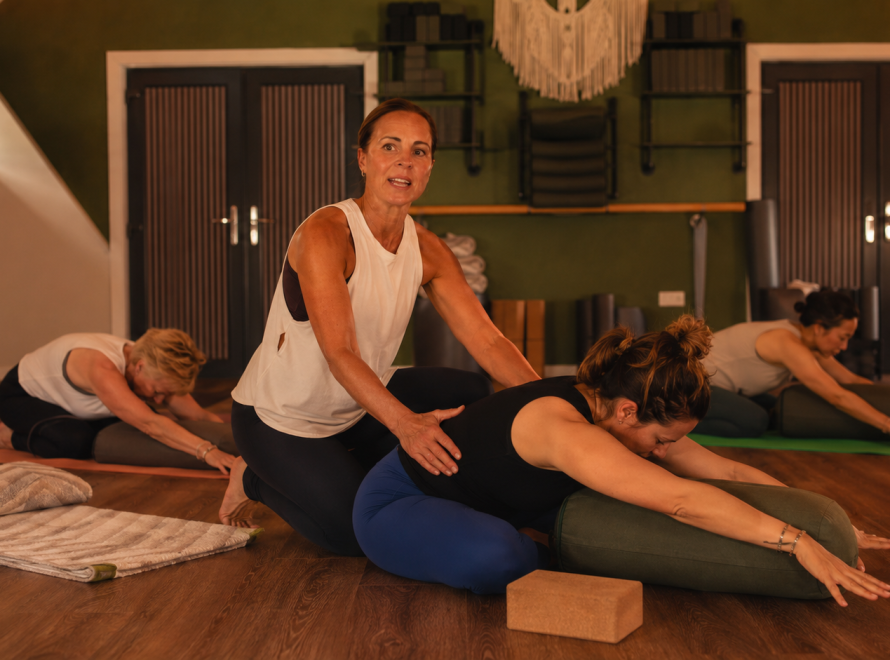
Most Yin classes use seated, reclined or kneeling positions. A teacher offers an entry point, suggests props and gives time to become still. Holds commonly last several minutes, although beginners may use shorter periods and change position sooner.
The muscular effort is often lower than in standing or flowing yoga, but “passive” does not mean collapsing into the deepest available range. Your joints still need support. A responsible approach is to find a position that produces manageable sensation without sharp pain, numbness, tingling or a feeling of instability.
Teachers may use anatomical or traditional language to describe the practice. Claims that a pose definitively changes a particular organ, “detoxifies” the body or permanently remodels fascia should not be treated as established fact. The clearest description is practical: Yin creates time for low-intensity movement, stillness, breathing and focused attention.
The Yin principle: begin well before your maximum range. Use enough support to remain steady, allow sensation to be present without chasing it, and leave the pose slowly.
Yin Yoga vs Restorative Yoga
Yin and Restorative Yoga are both slow, but they are not interchangeable. Yin often includes a deliberate, moderate sensation and asks you to observe how that sensation changes. Restorative Yoga generally uses more support so that the body can rest with minimal physical demand.
- Choose Yin if you want long-held positions, quiet attention and a measured physical component.
- Choose Restorative if your priority is comfort, rest and extensive prop support.
- Ask first if you are managing an injury, joint instability, pregnancy, surgery or symptoms that have not been assessed.
Read the YogaLife guide to Restorative Yoga vs Yin Yoga or explore Restorative Yoga classes.
Typical Yin yoga poses
Yin teachers frequently use descriptive pose names and may organise them differently from a Hatha or Vinyasa class. The examples below are common categories rather than instructions to practise alone.
Supported forward fold
A seated or wide-legged fold may use a bolster, bent knees or blocks. The goal is not to pull the torso towards the floor.
Butterfly variation
The soles of the feet come together while the knees are supported as needed. Distance between the feet and pelvis changes the experience.
Low lunge variation
A kneeling lunge may be supported under the back knee or hands. People with knee or hip concerns may need an alternative.
Reclined twist
A gentle supported rotation can be adjusted with blankets or bolsters. Twisting should never be forced by pressing on the legs.
Other classes may include supported hip-opening positions, side bends or a reclined rest. The sequence should respond to the group rather than treating a fixed list as compulsory.
Potential physical and mental benefits
Research into yoga more broadly suggests possible benefits for stress management, sleep, balance, general wellbeing and some pain conditions. However, yoga studies use different styles and populations, so results for “yoga” should not automatically be presented as proof for every Yin class.
A small body of research has examined Yin-based programmes, including anxiety and stress outcomes, but the evidence is not strong enough to promise a particular result. Individual experience depends on the teacher, class design, frequency, starting point and wider lifestyle.
More realistic reasons people may enjoy Yin include:
- time to slow down after a busy or active day;
- a low-impact contrast to running, gym work or dynamic yoga;
- an opportunity to practise breathing and sustained attention;
- gradual exploration of comfortable range of movement;
- learning to use props and reduce unnecessary effort.
Notice functional changes—such as feeling more comfortable in everyday movement or more settled after class—rather than judging success by how deep a pose looks.
What does a Yin class feel like?
A class may begin with a short arrival or breathing practice. The teacher then introduces a small number of positions, giving time to arrange props and choose an appropriate depth. Music, silence or occasional guidance may accompany the holds.
Some sensation is common, but it should remain manageable. You may notice the mind becoming restless before the body does. That is not a reason to remain trapped in a position: you can adjust, add support or come out at any time.
Transitions are usually unhurried. After a long hold, the area may feel temporarily unfamiliar or sensitive, so move slowly and pause before the next pose. The class commonly ends with a longer rest.
Who might Yin yoga suit?
Yin may appeal to beginners who prefer a quieter pace, experienced students who want a contrast to dynamic practice, or active people looking for a lower-intensity session. You do not need to be flexible, spiritual or able to sit still perfectly.
Slow does not automatically mean suitable for everyone. Long holds near end range may be inappropriate for some joint, nerve or connective-tissue conditions. People who are hypermobile may need to use less range and focus on stability rather than seeking more flexibility.
If you are pregnant, recovering from surgery, managing osteoporosis, joint instability, acute injury, nerve symptoms or persistent unexplained pain, obtain appropriate professional advice and tell the teacher before class.
Safety and useful modifications
- Start with shorter holds and come out sooner than the teacher suggests if needed.
- Use bolsters, blocks and blankets before discomfort becomes intense.
- Avoid bouncing, pulling or allowing another person to push you deeper.
- Stop for sharp pain, electrical sensations, numbness, tingling, dizziness or joint instability.
- Tell the teacher about relevant conditions, injury, pregnancy or recent treatment.
- Move out of poses slowly and take time before standing.
The National Center for Complementary and Integrative Health advises learning yoga under a qualified instructor and modifying or avoiding positions based on individual needs. Yoga should not be used to postpone assessment of a health problem.
Frequently asked questions
Is Yin yoga good for beginners?
It can be, provided the teacher gives clear options and the beginner understands that depth is not the goal. Arrive early, say that you are new and use props from the beginning.
Is Yin yoga the same as stretching?
Stretching can be part of the physical experience, but a class also includes stillness, breathing and attention. Not every Yin pose should be treated as a flexibility challenge.
How often should I practise Yin?
There is no universal frequency. Start with a class that fits your wider activity and recovery. Allow time to assess how you respond before adding more sessions.
Can Yin replace strength training?
No. Yin is not designed to provide the same progressive strength stimulus as resistance training. A balanced routine may include both strength and lower-intensity practices.
Continue exploring YogaLife
Further reading
Important: This article provides general information and is not medical advice. Work within your own limits and seek professional guidance when a health condition, injury, pregnancy or persistent symptom may affect participation.
SLOW DOWN WITH PURPOSE
Try Yin Yoga at YogaLife
Check the latest timetable and choose a class that fits your experience, energy and recovery needs.