
What Is Yoga Nidra? A Beginner’s Guide to Yogic Sleep
YogaLife Journal
Beginner’s guide · Wilmslow & Handforth · Updated August 2026
Yoga Nidra is a guided relaxation practice usually completed lying down. Here is what happens during a session, how it differs from meditation and what beginners can realistically expect.
The name Yoga Nidra is often translated as “yogic sleep”, but that description can cause confusion. You do not have to fall asleep, and the practice is not intended to replace ordinary sleep. Instead, a teacher guides your attention through a structured sequence while your body rests in a supported position.
A session may include body awareness, comfortable breathing, noticing sensations, visualisation and periods of quiet. There is usually very little physical movement once the practice begins, which makes Yoga Nidra different from a conventional yoga class.
This beginner’s guide explains what Yoga Nidra is, how a class is structured and what current research can—and cannot—tell us about its potential benefits.
What is Yoga Nidra?
Yoga Nidra is a guided practice of rest and focused awareness. It is usually completed lying on the back, although a side-lying or seated position can be used when that feels more comfortable.
The teacher provides a sequence of verbal instructions. Rather than concentrating on one subject throughout, you may be asked to move your attention between different parts of your body, notice your breathing or observe changing sensations.
The word “sleep” refers to the deeply restful quality associated with the practice. However, Yoga Nidra is not the same as an ordinary nap. Some participants remain aware of the instructions, some move between alertness and drowsiness, and others fall asleep.
None of these responses means that you have failed. The experience may also change depending on your energy, comfort, surroundings and familiarity with the practice.
How does Yoga Nidra work?
A Yoga Nidra session reduces the number of decisions you need to make. Your body is supported, movement is minimal and the teacher provides a clear sequence for your attention to follow.
This can be useful when unstructured rest feels difficult. Instead of being told simply to “relax”, you are given manageable instructions, such as noticing your right hand, listening to sounds in the room or following the natural movement of your breathing.
Although Yoga Nidra is sometimes described using claims about entering specific brain states or receiving several hours of sleep in a short session, these claims should be treated carefully. Yoga Nidra does not remove the biological need for sleep, and a class should not be presented as a replacement for medical care or healthy sleep habits.
Its practical value is simpler: it provides a structured opportunity to become physically comfortable, reduce external demands and practise directing your attention without needing to perform a sequence of poses.
Why this matters
Yoga Nidra should not be sold as a cure-all or a replacement for sleep. Its value comes from providing guided, repeatable rest without demanding flexibility, strength or complicated movement.
The stages of a Yoga Nidra class
There is no single sequence used by every teacher. However, many sessions follow a recognisable progression from physical preparation to guided awareness and then a gradual return to ordinary movement.
1. Arriving and getting comfortable
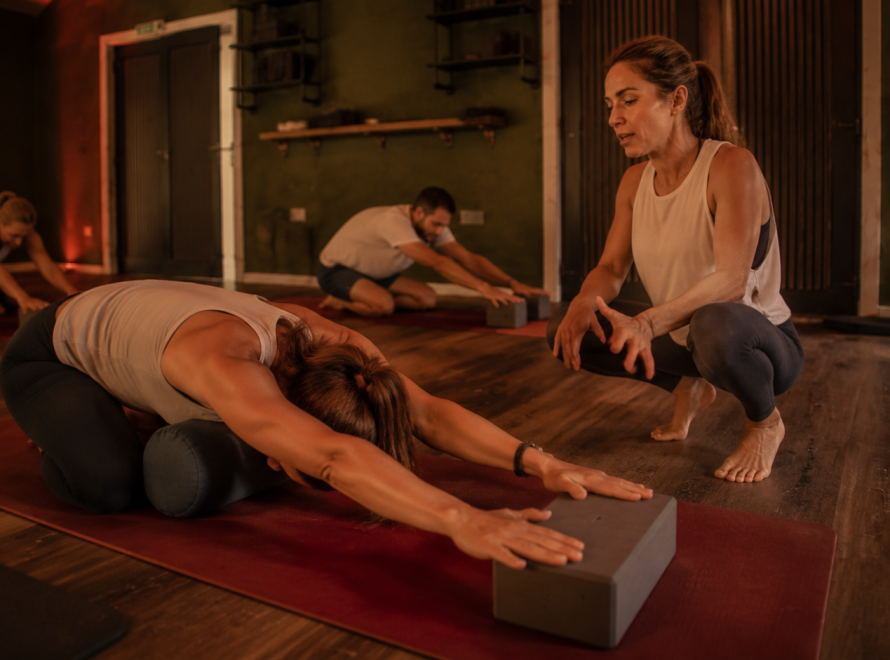
The class normally begins with time to settle. You may lie on a mat with a bolster beneath your knees, a blanket over your body and a thin support beneath your head.
Comfort matters because unnecessary physical strain can make it harder to follow the practice. You can adjust your position, lie on your side or sit in a supported chair when lying flat is unsuitable.
2. Settling your attention
The teacher may invite you to notice sounds, physical contact points or the general rhythm of your breathing. This helps create a gradual transition rather than expecting immediate stillness.
Some traditions include a short personal intention, sometimes called a sankalpa. This is optional and may be presented differently depending on the teacher.
3. Guided body awareness
You may be guided through different areas of your body in a set order. The instruction is usually to notice each area rather than move it, tense it or judge how it feels.
If focusing on a particular area feels uncomfortable, you can widen your attention to your whole body, return to sounds in the room or pause the exercise.
4. Breath awareness
The teacher may ask you to observe your natural breathing or notice movement around your abdomen, ribs or nostrils. Some sessions include gentle counting, but the breathing should not be forced.
If breath-focused exercises make you anxious or dizzy, return to normal breathing and use another grounding point, such as the feeling of the floor beneath you.
5. Sensations or imagery
Depending on the style, the teacher may guide you through contrasting sensations, simple images or a visualisation. You do not have to create a perfectly clear mental picture. Listening to the words is enough.
6. Quiet rest and returning
Towards the end, the amount of instruction usually reduces. You are then guided back gradually by noticing the room, deepening your breathing and introducing small movements.
Take your time when sitting up. Moving too quickly after lying still may leave you feeling light-headed or disorientated.
Potential benefits of Yoga Nidra
People practise Yoga Nidra for different reasons. Some want structured relaxation, while others use it as part of an evening routine, recovery day or broader meditation practice.
A structured way to rest
Yoga Nidra can make rest feel more accessible because you are not expected to create silence or relaxation by yourself. The teacher’s voice gives your attention a sequence to follow.
Minimal physical demand
Once you are comfortable, the practice normally requires little or no movement. This can make it a useful contrast to stronger yoga classes, running, gym training or a physically demanding working week.
Body and breath awareness
The guided sequence can help you notice where you are holding tension and how your breathing changes when you become more comfortable. The aim is observation rather than trying to force your body into a particular state.
Possible support for sleep
Some people use Yoga Nidra as part of a wind-down routine. A 2026 systematic review and meta-analysis found that the practice may have potential for sleep disturbances and insomnia. However, the review also found very low certainty of evidence, small study samples and methodological limitations.
Therefore, the findings should be treated as preliminary. Yoga Nidra may be a helpful relaxation practice, but it should not be described as a proven treatment for insomnia.
What Yoga Nidra does not promise
A session cannot guarantee that you will sleep better, remove anxiety or feel completely refreshed. You may sometimes finish feeling calm, while on another day you may simply notice how tired or distracted you are.
Judge the practice by realistic measures: whether you feel comfortable, whether the teaching style suits you and whether you are willing to return to it consistently.
What to expect from your first session
You do not need previous yoga experience, specialist flexibility or meditation knowledge. The physical part of the class is generally gentle, and the teacher will explain how to arrange your props.
What to wear
Choose comfortable clothing that does not restrict your breathing or dig into your body while lying down. Layers are useful because your temperature may change once you stop moving.
What to bring
- Comfortable clothing and an extra layer
- Water for before or after the class
- A yoga mat if the studio asks you to bring one
- Any personal support or medication you normally require
YogaLife’s Restorative Yoga and Yoga Nidra class uses props such as bolsters, blankets and blocks. Contact the team before your visit if you want to check what equipment is provided.
Tell the teacher what you need
Let the teacher know if you are pregnant, have an injury, find lying on your back uncomfortable or have another relevant health concern. A side-lying or seated version may be more appropriate.
You can also tell the teacher if closing your eyes, body scanning or visualisation feels uncomfortable. A well-led session should allow you to keep your eyes open, change position or opt out of part of the sequence.
What if you fall asleep?
Falling asleep is common, particularly when you are tired. It does not mean you have ruined the session. However, sleep is not a requirement, and remaining aware of some or all of the instructions is also normal.
Yoga Nidra vs meditation
Yoga Nidra is a form of guided meditative practice, but it is not identical to every other type of meditation. “Meditation” is a broad term covering many techniques, positions and traditions.
| Feature | Yoga Nidra | Seated meditation |
|---|---|---|
| Usual position | Lying down with physical support | Often seated, although other positions are possible |
| Level of guidance | Usually guided throughout most of the session | May be guided, partly guided or silent |
| Physical movement | Very little movement once comfortable | Normally still, with an upright posture |
| Focus | Attention may move through the body, breathing, sensations and imagery | Often uses one main focus, such as breathing, sound or open awareness |
| Falling asleep | Common but not required | Usually not the intention |
| Best suited to | People who want guided rest with minimal physical effort | People who prefer an upright or less scripted practice |
Neither approach is automatically better. Yoga Nidra may feel more accessible if lying down and following detailed guidance helps you settle. Seated meditation may suit you if you prefer alert stillness, fewer instructions or a practice that can be completed almost anywhere.
Frequently asked questions
Is Yoga Nidra suitable for beginners?
Yes. You do not need previous yoga or meditation experience. The teacher provides the instructions, and you can adjust your resting position whenever necessary.
Do I have to fall asleep?
No. The practice may make you feel drowsy, but falling asleep is not the goal or a measure of success. Remaining awake, drifting in and out of awareness or sleeping are all possible responses.
Is Yoga Nidra hypnosis?
No. Yoga Nidra is a guided relaxation and awareness practice. You remain free to move, open your eyes, ignore an instruction or end the session at any time.
How long does a session last?
The guided relaxation may last from approximately 15 minutes to an hour, depending on the class. A combined Restorative Yoga and Yoga Nidra session may include gentle movement and supported poses before the guided practice begins.
Can Yoga Nidra replace sleep?
No. Claims that a short Yoga Nidra session replaces several hours of sleep are not supported strongly enough to use as health advice. The practice may be restful, but your body still needs sufficient regular sleep.
Can I practise Yoga Nidra at home?
Yes. Choose a safe, comfortable place where you will not need to drive or complete another safety-sensitive task immediately afterwards. A guided class can still be useful initially because the teacher can help you arrange props and find a suitable position.
When to take action about sleep problems
Yoga Nidra can form part of a relaxing routine, but persistent sleep problems may require additional support. The NHS recommends speaking to a GP when changing your sleeping habits has not helped, you have experienced sleep problems for months or poor sleep is making daily life difficult to manage.
Seek professional advice if sleep problems are connected with significant anxiety, low mood, pain, medication, breathing interruptions or another health concern. Yoga Nidra should complement appropriate care rather than delay it.
Experience Yoga Nidra at YogaLife
YogaLife combines fully supported Restorative Yoga poses with guided Yoga Nidra in a calm studio environment. The class is suitable for complete beginners and people who want a slower, recovery-focused practice.
Check the current timetable before travelling and contact the team if you need help deciding whether Yoga Nidra, Restorative Yoga or Yin Yoga is the right starting point.
Sources and further reading
- Singh S, et al. Effect of Yoga Nidra in sleep disturbances and insomnia: systematic review and meta-analysis
- A closer look at Yoga Nidra: early randomised sleep laboratory investigations
- NHS guidance about insomnia and persistent sleep problems
Important: This article provides general information and is not medical advice. Seek appropriate professional guidance when persistent sleep problems, a health condition, injury, pregnancy or mental health concern may affect participation.
YOUR NEXT STEP
Rest, reset and experience Yoga Nidra
Join YogaLife’s Restorative Yoga and Yoga Nidra class in Wilmslow, near Handforth.