
Yoga for Stress Relief: Poses, Breathing and Classes That Help You Reset
YogaLife Journal
Practical wellbeing guidance · Wilmslow & Handforth · Updated August 2026
Five accessible yoga poses, a simple breathing exercise and practical class choices for days when your body feels tense and your mind will not slow down.
Yoga for stress relief is not about forcing yourself to relax or performing the most impressive pose in the room. It is about creating enough space to notice how you feel, move without rushing and reconnect with a comfortable breathing pattern.
Stress can affect people differently. You might notice tight shoulders, shallow breathing, poor sleep, racing thoughts, low energy or difficulty concentrating. Yoga will not remove the source of stress or replace professional support, but a suitable practice may give you a structured way to pause and reset.
This guide focuses on realistic, repeatable choices. You will find five gentle poses, a breathing exercise based on NHS guidance and an explanation of which YogaLife classes may suit you when you want movement, stillness or guided relaxation.
Understanding your stress response
The stress response prepares your body to deal with pressure. In short bursts, it can help you react quickly and stay alert. However, ongoing pressure can make it difficult to move out of that heightened state once the immediate demand has passed.
Physical signs may include a clenched jaw, raised shoulders, quicker breathing, headaches, restlessness or digestive discomfort. Emotionally, you may feel irritable, distracted, overwhelmed or unusually tired. There is no single correct way to experience stress.
A gentle yoga practice gives your attention something immediate and physical to follow. Instead of trying to stop every thought, you can notice the floor beneath you, the position of your hands and the pace of your next movement.
The aim is not to “switch off” your body on command. Instead, the practice should give you a manageable change of pace without creating another performance target.
Why movement can help when your mind feels busy
Remaining completely still can feel difficult when you are stressed. Slow, predictable movement may be easier because it gives you a sequence to follow. You can coordinate a movement with an inhale, complete another movement with an exhale and gradually reduce the urge to rush.
That does not mean the gentlest class is always the right choice. Some people prefer a flowing practice because it gives restless energy an outlet. Others need supported floor-based poses because an active session would leave them more depleted.
Use your present energy level rather than your usual ability as the starting point. A suitable stress-relief practice should generally allow you to:
- Breathe without straining or repeatedly holding your breath.
- Follow the pace without feeling rushed or confused.
- Use blocks, bolsters, blankets or a chair when needed.
- Leave a pose safely and independently.
- Finish feeling steadier rather than completely exhausted.
If you want to keep moving without the speed of a stronger Vinyasa session, YogaLife’s Vinyasa Slow Flow class offers breath-led movement at a more considered pace.
Five yoga poses for stress relief
The following poses can be practised individually or combined into a short sequence. Move gradually and stay within a range that feels controlled. A prop-supported version is often the most useful choice when the goal is to reduce effort.
1. Constructive rest
Lie on your back with your knees bent and your feet resting on the floor. Place your feet approximately hip-width apart and allow your knees to rest against each other if that feels comfortable.
Support your head with a thin folded blanket if needed. Let your hands rest on your abdomen, beside your body or wherever your shoulders feel relaxed. Spend one or two minutes noticing the support beneath you before trying to change your breathing.
2. Cat and cow
Move onto your hands and knees. Slowly round your spine as you allow your head to lower. Then lengthen your spine in the opposite direction without forcing your lower back or throwing your head backwards.
Repeat for six to ten comfortable breaths. Let the movement remain smaller than your maximum range. If placing weight through your wrists is unsuitable, practise a seated version by gently rounding and lengthening your spine on a chair.
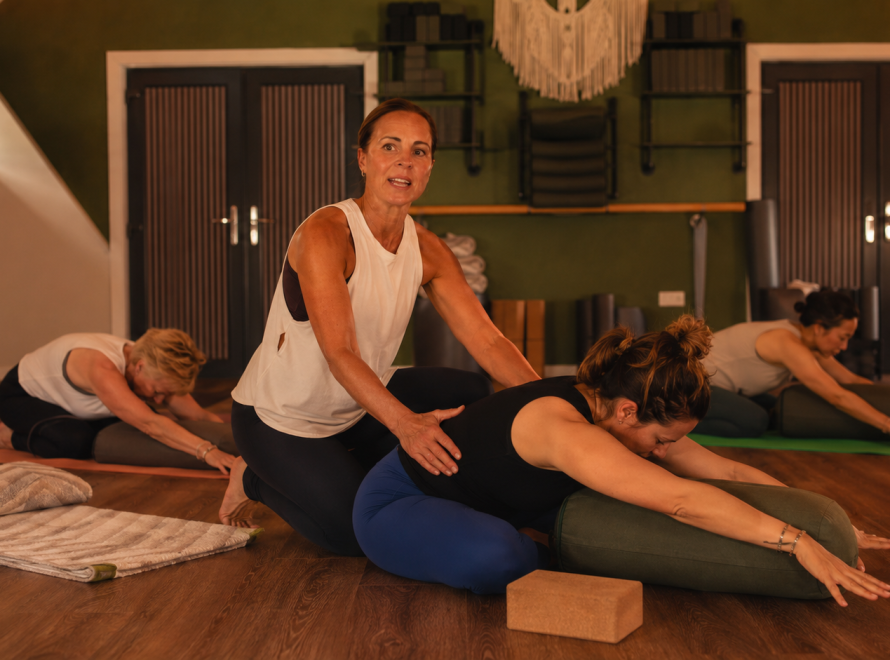
3. Supported child’s pose
From hands and knees, move your hips back towards your heels and lower your upper body. Your knees can stay together or move wider apart. Place a bolster or folded blankets beneath your chest and support your forehead.
Your arms can reach forwards or rest beside you. The supported version should allow you to reduce muscular effort. If the position causes discomfort around your knees, hips or lower back, return to constructive rest instead.
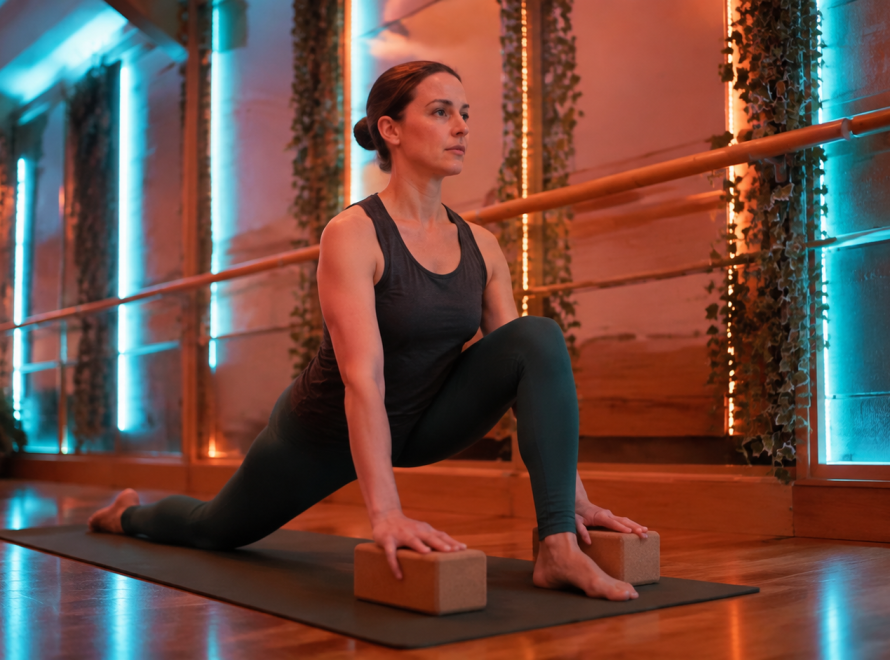
4. Supported low lunge
Bring one foot forwards between your hands and lower the opposite knee onto a folded blanket. Keep your hands on blocks or rest them on your front thigh. Allow your hips to move forwards only as far as feels stable.
A low lunge can provide a useful change after a day spent sitting, but it does not need to feel intense. Keep your front knee controlled, continue breathing and repeat the position on the other side.
5. Legs supported on a chair
Lie on your back and place your lower legs on the seat of a stable chair or sofa. Adjust your position until your hips, knees and lower back feel supported. Let your arms rest comfortably beside you.
Stay for two to five minutes if the position remains comfortable. This option can be easier to arrange than placing your legs vertically against a wall, and you can leave it simply by returning your feet to the floor.
Why this matters
The most useful pose is not the deepest one. Choose a version in which you can breathe normally, remain in control and leave the position without pain or panic.
A simple breathing practice for stress
Breathing exercises can be practised at the beginning or end of a yoga session. They can also be used on their own when you do not have the time or energy for a full physical practice.
The NHS breathing exercise for stress uses comfortable, regular breathing and can be completed while sitting, standing or lying down.
- Choose a comfortable position and loosen anything that restricts your breathing.
- Allow your breath to move into your abdomen as far as feels comfortable. Do not force it.
- Breathe in gently through your nose.
- Count steadily from one to five if that feels natural. You do not have to reach five.
- Let your breath flow out gently, counting from one to five again if helpful.
- Continue for up to five minutes.
Avoid trying to take the biggest possible breath. Quiet, comfortable breathing is more useful than forcing extra air into your lungs. You also do not need to hold your breath between the inhale and exhale.
If counting makes you more tense, return to your normal breathing pattern. Focus instead on a neutral physical reference, such as the feeling of your feet against the floor or your back being supported by a chair.
Stop the exercise if focusing on your breathing increases anxiety or makes you feel dizzy. Breathing practices should remain optional rather than becoming another task you feel pressured to complete correctly.
Which yoga classes can support relaxation?
The right class depends on whether you want movement, supported stretching or guided rest. Class names can be helpful, but the exact pace and sequence will vary between teachers.
Vinyasa Slow Flow
Vinyasa Slow Flow connects breathing with steady movement. It may suit you if complete stillness feels difficult or if you want a calmer practice that still develops mobility, coordination and gentle strength.
Restorative Yoga
Restorative Yoga uses bolsters, blankets and blocks to support the body in restful, floor-based positions. Poses are held for longer without trying to create an intense stretch.
Restorative Yoga and Yoga Nidra
Restorative Yoga and Yoga Nidra combines supported postures with guided relaxation. Yoga Nidra is generally practised lying down while listening to the teacher, making it suitable when you want minimal physical effort.
Yin Yoga
Yin Yoga is a quiet, floor-based practice with longer-held positions. It can suit people who enjoy stillness and gradual stretching. However, longer holds may still feel physically demanding, so use props and avoid forcing your range.
YogaLife’s Wilmslow studio uses infrared warmth for many classes. Temperature and intensity can affect how a session feels, so check the individual class description and contact the team if you prefer a gentler or less heated option.
What you can do now: a 15-minute routine
This routine can help create a transition after work, before bed or between a demanding part of the day and your evening. You do not need to complete every stage.
- Minutes 0–2: Constructive rest. Lie down with your knees bent and notice where your body meets the floor.
- Minutes 2–4: Cat and cow. Move slowly through a comfortable range without forcing your spine or neck.
- Minutes 4–7: Supported low lunge. Spend approximately 90 seconds on each side, using blocks and a folded blanket.
- Minutes 7–10: Supported child’s pose. Support your chest and forehead so the position requires less effort.
- Minutes 10–13: Gentle breathing. Use a comfortable count without holding or forcing your breath.
- Minutes 13–15: Quiet rest. Return to constructive rest or place your lower legs on a chair.
On a lower-energy day, five minutes of supported rest and comfortable breathing may be enough. A short routine you can return to is more useful than an ambitious plan that becomes difficult to maintain.
When to take action and get additional help
Yoga can form part of a wider wellbeing routine, but it is not a treatment for every cause or symptom of stress. Speak to your GP if stress, anxiety or low mood persists, becomes difficult to manage or affects your sleep, work, relationships or daily life.
If you are pregnant, have an injury or live with a condition that may affect exercise, ask an appropriate healthcare professional for advice. Tell your yoga teacher about relevant limitations before the class begins so they can explain suitable alternatives.
Stop exercising if you develop pain, chest discomfort, severe breathlessness, numbness or feel faint. Do not use relaxation or breathing exercises to delay seeking medical help for a new or concerning symptom.
If you need urgent mental health support but it is not an emergency, use NHS 111 online or call 111 and select the mental health option. If you or somebody else is in immediate danger, call 999 or go to A&E. The NHS also explains where to get urgent mental health help.
Frequently asked questions
Can beginners use yoga for stress relief?
Yes. Beginners can start with accessible floor-based poses, gentle breathing and slower classes. Choose a teacher who explains alternatives and encourages you to work within a comfortable range.
How often should I practise?
Choose a frequency that fits your week and leaves enough time for recovery. This might mean one guided class each week with a few minutes of breathing or gentle movement at home on other days. Consistency matters more than making every session long.
What if I cannot switch my thoughts off?
You do not need to empty your mind. Notice when your attention wanders and gently return it to a physical reference point, such as your breathing, the feeling of your feet or the teacher’s next instruction.
Is Restorative Yoga the same as Yin Yoga?
No. Restorative Yoga generally uses more support and aims to minimise physical effort. Yin Yoga also uses floor-based positions, but the poses may produce a more noticeable stretch and are often held for several minutes.
Is an active yoga class still useful when I feel stressed?
It can be. Some people prefer flowing movement because it gives restless energy an outlet. Choose an intensity you can control and avoid treating exhaustion as proof that the class has worked.
Choose your next YogaLife class
If you are looking for yoga for stress relief in Wilmslow or Handforth, begin with the class that matches your current energy. Choose Vinyasa Slow Flow if you want calm movement, or try Restorative Yoga and Yoga Nidra when you need more support and stillness.
Check the current timetable before travelling. If you are unsure which session to choose, contact YogaLife and explain whether you prefer flowing movement, supported stretching or guided relaxation.
Sources and further reading
Important: This article provides general information and is not medical advice. Work within your own limits and seek professional guidance when a health condition, injury, pregnancy or persistent symptom may affect participation.
YOUR NEXT STEP
Find a class that helps you reset
Explore YogaLife’s Slow Flow, Yin, Restorative and Yoga Nidra sessions in Wilmslow and Handforth.